RSS Feed
 Twitter

 July 27th, 2011
  Linda Mattacks
 Writing to Sell and Writing for Social Media are different!
Social media readers and followers are, by and large, very forgiving of misspellings, commas in the wrong place and so on because we like the fact that the writer is maybe thinking aloud rather than giving a pre-prepared speech.
It can be a costly mistake to expect the same leeway from a potential buyer – someone who expects certain standards to be met…
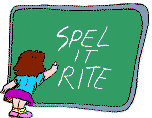 Getting the right there, they’re or their … pear, pare or pair … doesn’t seem to carry much importance nowadays. But it still means a lot to me and probably to anyone else who went through schools in the education system that made you feel like a right – yes that’s right, not rite or write 😉 – plonker if you got it wrong…
So when I sent off for a write-to-sell programme, with a price tag of over £250 a few years ago and found my intake was constantly being interrupted by glaring and more and more intrusive grammatical and spelling whoopsies on every single page…  I complained. The author of the course said words to the effect of: “Whoops! Okay. Keep it. We’ll return your money and please can we have your proofed pages?” Fair enough deal to me.
 There was some good stuff there though I found it a bit annoying that much of the content and examples were gleaned from America despite the fact that the course creator was born and based in Ireland. I remember thinking that I wouldn’t have used the material without making it UK-market friendly first. (I wonder if nowadays you could watch a series of Mad Men and learn just about as much? Nah! Silly thought…)
Surprisingly (to me) much of the information was along very similar lines I’d learned way back when I was a classified advertising telephone sales person and then as a trainer in the 1970s and 80s:
When the only discounts we sales people could give were those printed on the rate card, we learned how to add value in other ways – i.e. become mini copywriters for the column we worked on and help our advertisers ‘sell’ their wares.
Anyway, here’s the headline stuff that would seem never to really change… and it’s still based on a mate that’s been around for years: A.I.D.A…
Attention
- 90% of the reason anyone responds to a sales message is because of what’s in the headline or opening statement
- An effective headline can bring in up to 17 times more response than an ineffective, weak one, even if the rest of the copy is the same?
Your headline / first line of communication should include at least one of:
- Self interest
- Curiosity
- News
Combine this little lot and you’ve made a cracking start – remember, tempting though it may be, you’re really not trying to attract the whole world!
Interest
Now you’ve grabbed the attention of those potentially in your market you need to hold onto it and really start to address the “What’s in it for me?” question.
It’s estimated that only 20% of people who are initially attracted by a headline actually continue on to read the rest of the message. So what’s going to hold me once you’ve grabbed me?
- Blah, blah, blah experts … join the ranks of our elite…
- Blah, blah, blah expertise/ training/ consultancy, as used by… offered…
- Fabulous… for discerning …
Start filling out your spiel with the information that typifies what your best clients/ customers or potential employer (s) were looking for when they first came to you.
Make your readers feel comfortable – that they’ve come to the right place…
Desire
If YOU can’t get any enthusiasm going you might as well forget the idea of whipping up any from a potential punter!
This is where your presentation of offer comes in. The ‘Gurus’ all agree “Free is good” here – it may sound corny but it works a treat for many 😉 …
- FREE trial
- FREE estimate
- FREE audit
- FREE demonstration
- FREE delivery
- FREE information
- FREE survey
- FREE report
If FREE doesn’t work for you, or you have something really different to offer, you could lob in alternative or additional sweeteners for good measure…
- Unique benefit
- Unique guarantee
- Etc. – get creative…
Action
This may sound incredibly obvious but it’s nothing short of criminal how many of us fall at the final hurdle by simply assuming that our buyer will know what to do next… and don’t bother to tell him or her.
So make it clear what the next move should be
You can add a P.S. (and a P.P.S.) to inject some urgency into the action you want the recipient and reader to take. In my opinion, I’d say be a little bit wary of how you use the P.S and P.P.S .and avoid the P.P.P.S: They were done to death in the late 90s – don’t knock it – some of the people around then will be recipients of your current masterpieces…
Finally
This is just the start – the words. There’s tons more to consider with regard to making creations look good: layout, typeface, sub headings, strap lines, images (logos, pictures, etc.) and colour.
And you’ve got to make sure your masterpiece gets to the right people…
With a message that resonates…
Hopefully catching them when they’re prepared to listen/ read…
But we’ll leave that till another time …
Linda
P.S. Let us know what you think… 😉
P.P.S.
I contributed the bones of this post first as a guest on another site back in June.
Since then I’ve had several comments and compliments about how down to earth and helpful the information has been to people in vastly different walks of life and businesses. So it was obvious in retrospect that I’d goofed: I should have posted it here so that our regular readers, many of whom have been with us since 2006 when we first started this site, could easily see it.
So I decided to put that right…
I altered the title – it’s now actually much closer to the one I originally gave it but somehow got changed by the time it was published, so it’s as it should be on its “home” territory! And I beefed up the content for you…
It’s a bit longer than most of the posts we publish here but it’s very meaty so you may want to bookmark it so you can refer to it when you want/ need to…
 Posted in
  Tags:
Tags: